
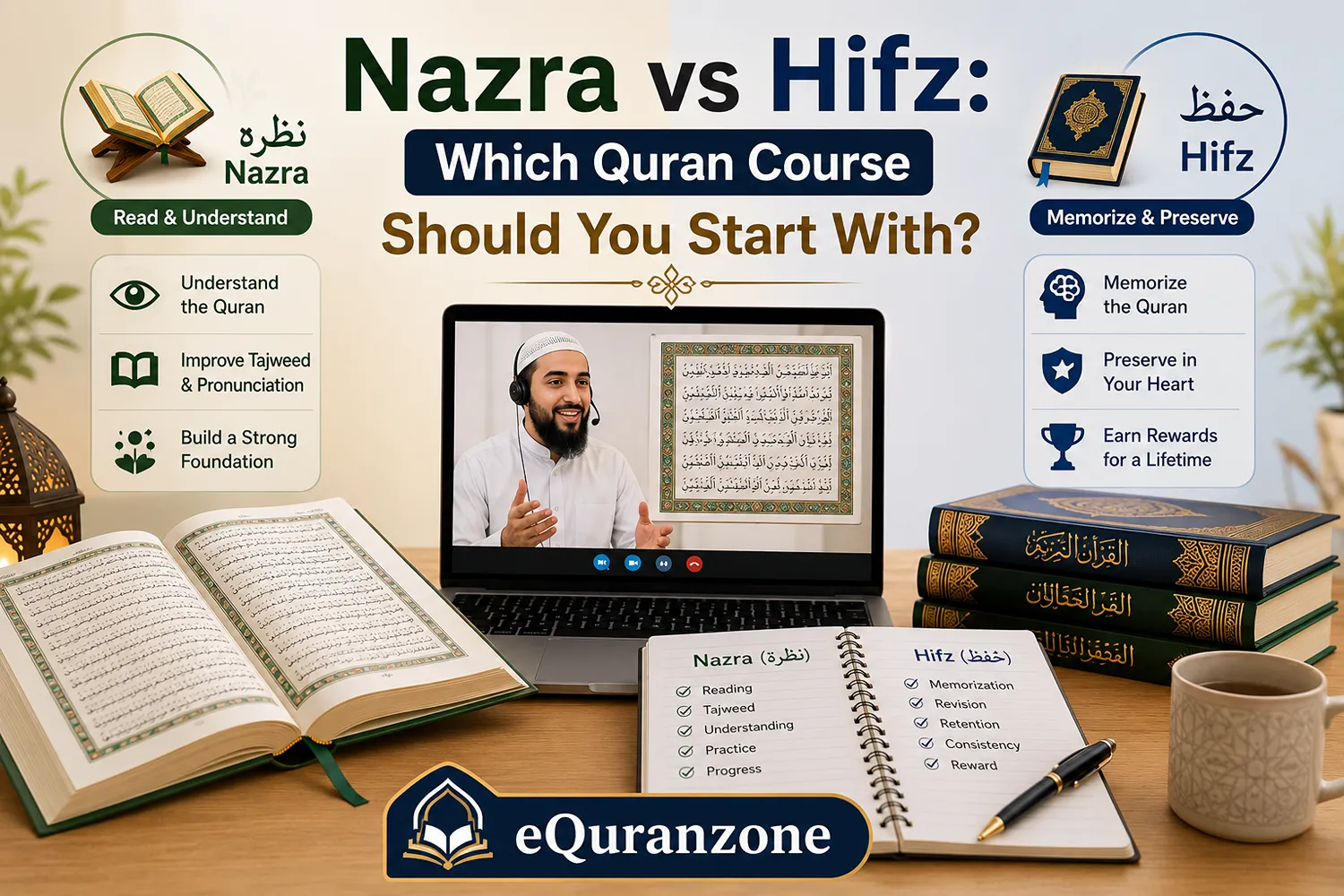
Nazra vs Hifz: Which Quran Course Should You Start With?
If you’ve been looking into online Quran classes for yourself or your child, you’ve probably come across these two terms and wondered what actually tells them apart. Nazra Quran means learning to read the Quran with correct pronunciation, moving through the pages steadily until reading feels natural. Hifz means something bigger: memorizing the entire Quran, all thirty paras, so it lives in the heart and not just on the page. The Nazra vs Hifz question comes up almost every week at eQuran Zone, usually from parents in the USA, UK, Canada, and the Gulf who aren’t sure where to begin. This guide walks through what each path actually involves, how they differ day to day, and which one probably makes sense for you right now.
What Is Nazra Quran?
Nazra is the reading stage. It’s where a student learns each Arabic letter, how sounds change when letters join together, and how to read the Quran directly from the mushaf without stumbling over words. Most students start here, and for good reason — it’s hard to do anything else in Quran learning until reading itself feels comfortable.
At eQuran Zone, this usually begins with the Noorani Qaida for absolute beginners, which covers the alphabet and basic rules before a student moves into full Quran Reading. Once reading a page feels smooth, attention often shifts to correct pronunciation through the Tajweed Course, so reading isn’t just fast but genuinely accurate. Nazra on its own is a complete, meaningful goal for plenty of families — many adults simply want to read the Quran with confidence and stop right there.

What Is Hifz (Memorization)?
Hifz is the next level up — committing the entire Quran to memory, word for word, so it can be recited without looking at a page. It’s a serious, multi-year commitment, and also one of the most respected achievements in Islamic tradition. Someone who completes it is known as a hafiz.
According to Wikipedia’s overview of the hafiz tradition, the Quran contains 114 surahs and roughly 6,236 verses, preserved through an unbroken chain of memorization that stretches back to the Prophet’s companions. That’s the scale of what a Hifz student is working toward, which is exactly why the process is broken into small, steady daily portions rather than rushed.
Our Hifz Quran course is built around that pace — one-on-one sessions where a tutor listens to new memorization, revises older portions, and corrects mistakes on the spot. It works well for children starting young, but plenty of adults join too, especially once their Nazra reading is solid.
Key Differences Between Nazra and Hifz
The two aren’t competing goals — Hifz is usually built on top of Nazra, not instead of it. Still, they differ in a few practical ways worth knowing before you commit to a schedule.
- Goal: Nazra aims for fluent, correct reading. Hifz aims for full memorization with recitation from memory, no page needed.
- Time: Nazra can often be finished in months. Hifz typically takes two to five years, depending on age, pace, and how many weekly classes a student takes.
- Daily practice: Nazra needs regular reading practice. Hifz needs daily new memorization plus ongoing revision of everything learned before it.
- Starting point: Nazra can begin right after Noorani Qaida. Hifz works best once reading and basic Tajweed already feel comfortable.
- Who it suits: Nazra suits almost anyone who wants to read confidently. Hifz suits those ready for a long, disciplined commitment.
If you’re weighing the difference between Nazra and Hifz Quran for your own family, the honest answer is that one usually leads into the other. Jumping straight to memorization without reading fluency already in place tends to slow a student down rather than speed them up.
Which One Should You or Your Child Start With?
If You’re an Adult Beginner
Most adults joining our Quran Classes for Adults start with Nazra, and that’s the right call even if Hifz is the long-term dream. Reading fluency builds the tools — correct letter sounds, joined-up reading, basic Tajweed — that make memorization realistic later instead of frustrating. There’s no shame in starting from the beginning as an adult; a good number of our students are parents who want to read alongside their kids.
If You’re Enrolling Your Child
For children, the decision often comes down to age and how they took to Noorani Qaida. A child who reads smoothly and enjoys repetition might be ready to start light Hifz alongside continued reading practice. One who’s still working on pronunciation is usually better served spending more time in Quran Reading first, paired with Islamic Studies for Kids so learning stays well-rounded rather than recitation-only.
Either way, don’t just guess. A short assessment with a tutor tells you far more than weeks of wondering. That’s exactly what a free trial class is for no pressure, just an honest look at where a student actually stands.
Getting the Right Guidance From the Start
eQuran Zone runs one-on-one classes over Zoom, Teams, or WhatsApp, with both male and female tutors available so families can pick whatever feels comfortable. Because every class is just one student and one tutor, the pace adjusts to the learner — nobody’s rushed through Nazra to hit a Hifz timeline, and nobody capable of moving faster gets held back either.
Pricing is straightforward too. Plans start at $30 a month for three classes a week, up to $40 a month for five classes a week, all one-on-one either way, just with more frequent sessions for families wanting faster progress. Full details, including UK, Canada, and Gulf pricing, are on the pricing page. You can also read more about our teaching approach and tutors on the about page.
If you want to see everything on offer beyond Nazra and Hifz, the courses page lists it all, and the Online Quranic Studies blog category has more comparisons like this one if you’re still deciding. There are also free downloadable resources worth grabbing for extra reading practice at home.
Frequently Asked Questions
What isNazra vs Hifz?
Nazra means learning to read the Quran directly from the page with correct pronunciation. It doesn’t involve memorization — the goal is simply confident, accurate reading, usually built after finishing Noorani Qaida.
What does Hifz mean?
Hifz means memorizing the entire Quran by heart so it can be recited from memory without a written copy. It’s a long-term commitment usually taken up once reading fluency is already in place.
Can a beginner start Hifz directly?
It’s possible, but it isn’t recommended. Without solid reading and basic Tajweed first, memorization tends to lock in mispronunciations that are harder to fix later. Most tutors suggest a short Nazra foundation before starting Hifz, even if it’s only a few months.
How long does Nazra take before starting Hifz?
It varies by age and how often a student practices, but most people build a solid Nazra foundation in six months to a year with regular classes. Once reading is smooth and mistakes are rare, moving into Hifz becomes a natural next step.
Is Hifz harder than Nazra?
Hifz demands far more time, daily discipline, and ongoing revision, so yes, it’s considerably more demanding than Nazra. Nazra is a shorter, more contained goal, while Hifz is closer to a multi-year commitment woven into daily life.
Can adults learn Hifz Quran online?
Yes, plenty of adults take up Hifz later in life, often alongside work or family responsibilities. One-on-one online classes make this realistic since the schedule and pace are built around the student rather than a classroom group.
Do I need to learn Tajweed before starting Hifz?
Basic Tajweed alongside solid Nazra reading is strongly recommended before starting Hifz. It’s much easier to memorize correct pronunciation from the start than to unlearn mistakes later on.
Conclusion
There’s no universally right answer to Nazra vs Hifz it depends on where you or your child are starting from, and what you’re hoping to get out of Quran learning. Nazra gives you fluent, accurate reading in a matter of months. Hifz asks for years of steady daily commitment but leads somewhere much bigger. Neither path is wrong; they’re just different distances.
Not sure which course fits you? Ask us in a free trial class a tutor can assess reading level in one session and recommend a realistic starting point, no pressure attached. You can also reach out through WhatsApp or the contact page first if you’d rather talk it through before booking anything.


