
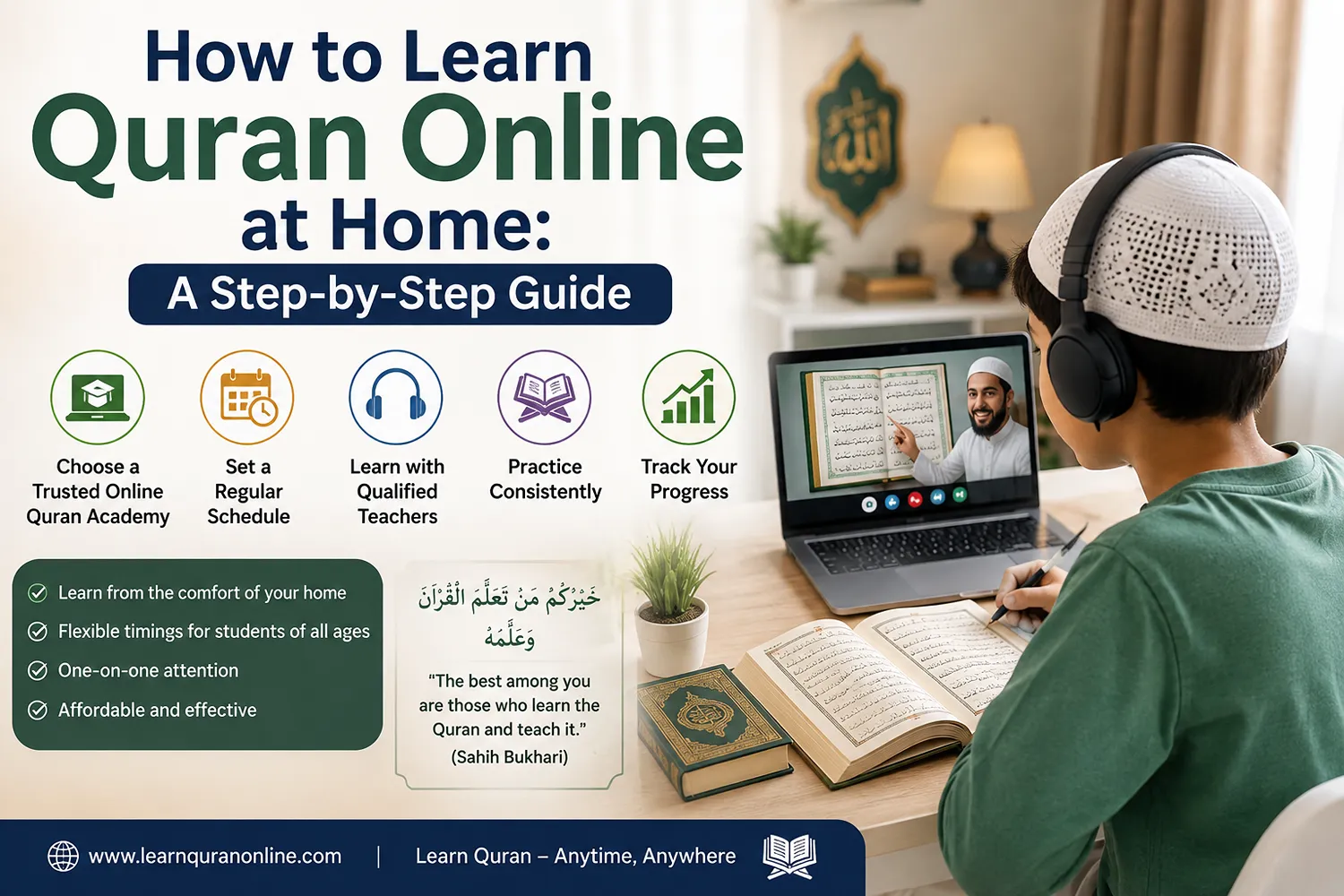
Plenty of people want to read the Quran but never start. The reason is almost always the same. They do not know what the first step is, or they think they are too old, too busy, or too far behind.
None of that is true. Learning the Quran from home is more doable today than at any point in history. You need a plan, a little consistency, and the right support. This guide gives you all three, in plain steps you can follow starting this week.
How do you learn Quran online at home?
To learn Quran online at home, start with Noorani Qaida to master Arabic letters and sounds, then move to reading short surahs with basic Tajweed, and practice a little every day with a qualified online teacher who corrects your mistakes in real time. Consistency matters more than long sessions.
That is the whole path in one paragraph. The rest of this guide breaks each part down so you know exactly what to do and in what order.

What do you need before you start?
Less than you think. A quiet spot, a device with a camera, a stable internet connection, and a copy of the Quran, physical or digital. You can read and listen to the full text for free on Quran.com while you get set up.
The one thing that changes everything is a teacher. Self-study can get you reading letters, but a live teacher hears your pronunciation and fixes errors before they set in. That is the difference between guessing and knowing. You can test this with a free trial Quran class before spending anything.
Step-by-step: how to learn the Quran from home
Here is the order that works for almost every beginner, child, or adult.
- Set your intention and a small goal. Start with 15 to 20 minutes a day, not an hour. Small and daily beats long and rare.
- Learn Noorani Qaida first. This teaches the Arabic letters, their shapes, and their sounds. Skipping it is the most common beginner mistake. Start with Noorani Qaida.
- Master letter pronunciation (Makharij). Get the sounds right early. Fixing them later is much harder.
- Begin joined reading. Move from single letters to short words, then short verses. A structured Quran reading course walks you through this.
- Add basic Tajweed rules. Learn the essential rules that keep recitation correct, like the rules of Tajweed and finer points such as Qalqalah.
- Start with Juz Amma. The last part of the Quran has short, familiar surahs. It builds confidence fast.
- Practice daily and review. Revisit yesterday’s verses before learning new ones. Review is where progress locks in.
- Understand what you read. Once reading is smooth, add meaning. It keeps you connected and motivated.
Follow these in order, and you will feel real progress within weeks, not years.
Can you learn the Quran by yourself at home?
Partly, yes. You can learn to recognize letters and even read slowly using apps, videos, and free resources. Many people reach basic reading on their own.
But there is a ceiling. Pronunciation and Tajweed are almost impossible to self-correct, because you cannot hear your own mistakes the way a trained ear can. This is why most serious learners pair self-study with a teacher. If you are weighing it up, this piece on whether online Quran learning is effective is honest about what works.
Self-study vs learning with an online teacher
Both have a place. The trick is knowing what each one is good for.
| Factor | Self-study | With an online teacher |
|---|---|---|
| Cost | Free or very low | Small monthly fee |
| Pronunciation accuracy | Hard to correct alone | Corrected live, lesson by lesson |
| Pace and structure | You set it, easy to drift | Clear plan, steady progress |
| Motivation | Depends fully on you | Teacher keeps you accountable |
| Best for | Reviewing, casual reading | Beginners and anyone serious |
For most beginners, the honest answer is a mix. Use free resources to practice between lessons, and lean on a teacher for the parts you cannot judge yourself, ideally in one-on-one Quran classes where all the attention is on you.
How long does it take to learn to read the Quran?
Most beginners can read the Quran slowly within four to eight months of steady daily practice, though this varies by age, starting point, and how often you practice. Reading fluently with good Tajweed takes longer, often a year or more.
Do not let those numbers discourage you. The goal is progress, not speed. A child of six and an adult of sixty both get there on the same road, just at their own pace. Structured plans for adults and kids are built around exactly this.
How to stay consistent when motivation dips
Every learner hits a slow patch. The people who succeed are simply the ones who kept the habit through it.
A few things that genuinely help. Keep sessions short so they never feel like a chore. Attach the lesson to something you already do daily, like right after Fajr or dinner. Track your progress, even a simple tick on a calendar, so you can see how far you have come. And when you plateau, review old material instead of forcing new lines, because a small win rebuilds momentum.
Learning as a family works too. Parents and children practicing together stay far more consistent than anyone learning alone. If your aim later is memorization, this guide on the best way to do Hifz online has practical retention tips.
Making it work for the whole household
Home learning has a quiet advantage that classrooms lack. Everyone can join at their own level.
A parent can take a beginner reading course while a child starts Qaida, using the same platform at different times. Younger children do better with short, playful sessions, while adults can handle longer blocks. When the Quran becomes part of the household routine rather than one person’s task, it tends to stick for good. Our learn Quran online setup is designed to support several family members at once.
Common mistakes to avoid
A few slip-ups slow almost every beginner down. Knowing them in advance saves you months.
The first is skipping Qaida and jumping straight to surahs. It feels faster, but weak foundations show up later as stubborn errors. The second is chasing quantity, reading many verses without reviewing old ones, so nothing sticks. The third is practicing in long, irregular bursts instead of short daily sessions. And the fourth is staying fully self-taught for too long, which lets small pronunciation faults harden into habits. Avoid these four, and you are already ahead of most learners.
Frequently asked questions
How can I learn the Quran by myself at home?
You can start by learning Noorani Qaida through apps and videos, practicing letter sounds daily, and reading along with audio from a reliable source. For correct pronunciation and Tajweed, pair your self-study with an online teacher, since these are very hard to fix on your own.
What is the easiest way to learn the Quran for beginners?
The easiest way is to follow a clear order: letters first with Qaida, then short words, then short surahs from Juz Amma, adding basic Tajweed as you go. Keep sessions short and daily, and get a teacher to correct you early.
How long does it take to learn to read the Quran?
With steady daily practice, most beginners read slowly within four to eight months. Fluent recitation with proper Tajweed usually takes a year or more. Your age, starting level, and consistency all affect the timeline.
Can I learn the Quran without knowing Arabic?
Yes. You learn to read the Arabic script and pronounce the words before you learn the language itself. Understanding the meaning comes later and is a separate step, so a lack of Arabic should never stop you from starting.
Is learning the Quran online at home effective?
For most learners, yes. One-on-one online lessons give you a teacher’s full attention and a structured plan, which often works better than a busy in-person class. Consistency and a qualified teacher matter more than the setting.
What should a complete beginner start with?
A complete beginner should start with Noorani Qaida, which teaches the Arabic letters and their sounds. This foundation makes everything after it, from reading to Tajweed, far easier and faster to pick up.
Your first step
Learning the Quran at home is not about talent or age. It is about starting with the right step and showing up regularly. Begin with the letters, add a teacher for the parts you cannot self-check, and keep your daily practice small enough to actually keep.
The hardest part is the first lesson, and you can take it this week. Book a free trial with eQuran Zone, meet a teacher, and start reading the very first day. Register now and turn the intention you have been carrying into a habit.


