
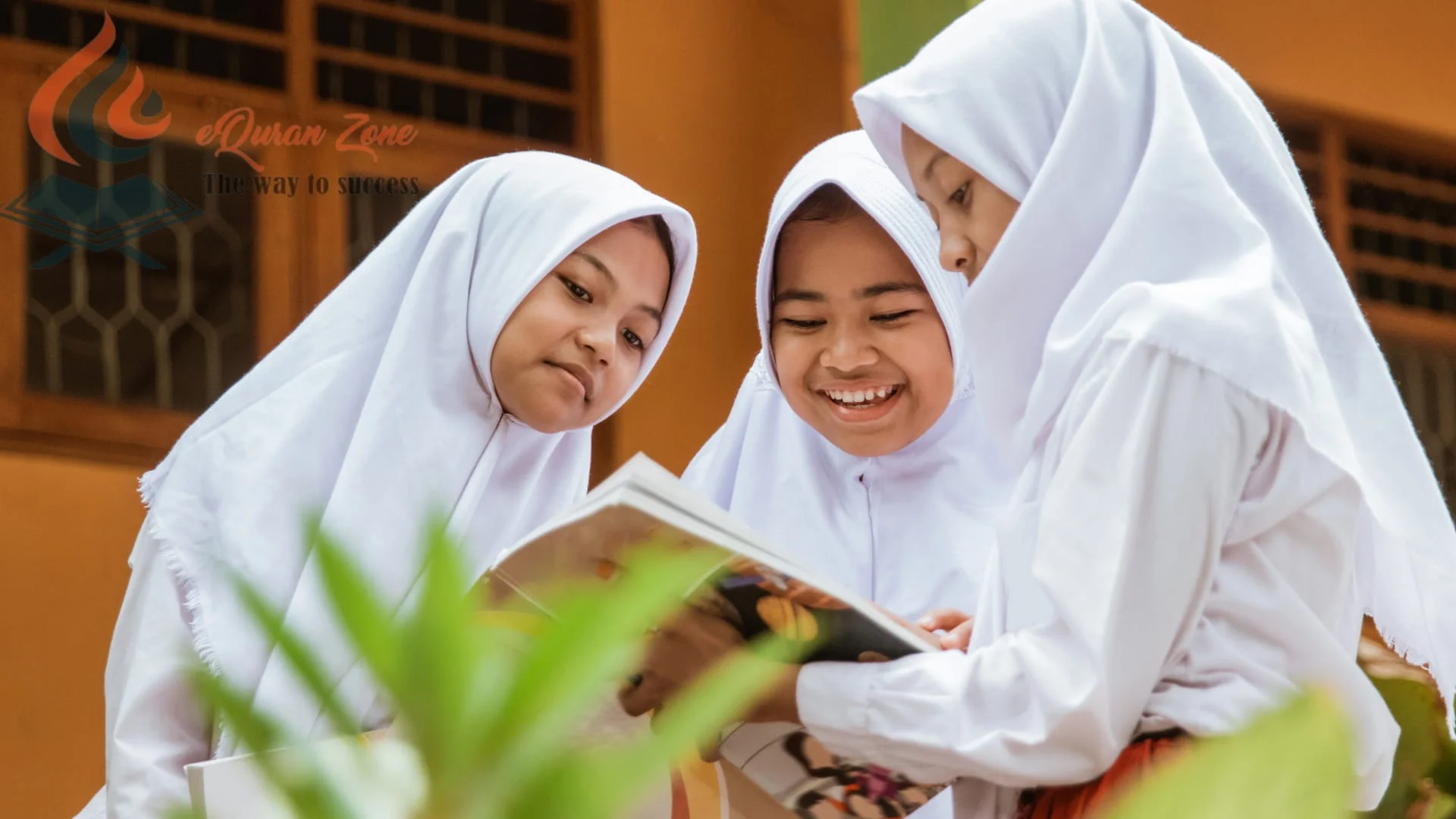
Islamic studies for kids is an organized method of learning the basics of Islam (Aqidah, beliefs, Fiqh, worship, Seerah, the life of the Prophet (saws), and stories from the Qur’an, short Hadiths, daily prayers (Dua), and Islamic manners. Simple stories and repetition are good for children as young as 4 years, and structured lessons work best from 6-7 years on. At eQuranzone, we want to guide Muslim families on the best way to educate their children with Islam, whether at home, online, or with the best available curricula.
What is Islamic Studies for Kids?
Islamic studies for kids is not just a continuation of the general religious studies that children receive in school; it’s a building block of religious education that starts from the foundation and establishes the identity of the child as a Muslim. This isn’t only a matter of memorizing facts. It is about developing a sense of love for Allah, understanding the Prophet Muhammad (Saw), and having a character formed by Islamic values in children.
A competent Islamic education curriculum for children should include:
- Aqidah: Who is Allah? What do Muslims believe?
- Fiqh: How do we pray, make Wudu, and follow the Five Pillars?
- Seerah: The life, character, and message of Prophet Muhammad ﷺ
- Quran: Recitation, short Surahs, and stories from the Quran
- Hadith: Short, age-appropriate sayings of the Prophet ﷺ
- Duas: Daily supplications that connect children to Allah in everyday life
- Akhlaq: Islamic manners, honesty, kindness, respect
These are taught together in a considered and age-appropriate fashion, and the children are not merely taught Islam; they begin to live it.

Why Does Islamic Studies for Kids Matter?
Children absorb what they see. Children are sponges. They are absorbing all that they see, hear, and feel in their environment. The way that they are educated in their young years will influence the kind of adults they will become. Islamic studies for children are important because:
- It fosters a robust Islamic identity; children are aware of their identity, their origins, and their beliefs.
- It provides them with the answers to questions they have, such as ” Who created us? Why do we pray? So, who are the Prophets?
- It builds character and values, honesty, gratitude, patience, respect, are not just cultural ways of doing things; they are Prophetic teachings!
- It brings them closer to the Quran and Sunnah, and makes it personal and meaningful, instead of distant and dry.
- It equips them to advance with faith as their foundation in the challenges of today’s world.
As a child grows up, the earlier he is introduced to Islam lovingly and happily, the stronger will be his bond with Islam.
What Is the Best Age to Start Islamic Studies for Kids?
One of the more frequent queries parents of Muslims might ask is when it is too early to begin. The answer may come as a surprise, but it is never too soon as long as the approach is at the child’s level. Let’s look at a breakdown by age:
- Ages 2,3: The Seed Stage
- Ages 4,6: Foundation Stage (Mini Believers)
- Ages 6,9: Structured Learning Stage (Little Believers)
- Ages 10,14: Deepening Knowledge Stage (Young Believers)
- Ages 15,18: Teen Stage (Advanced Islamic Study)
Core Topics in Islamic Studies for Kids: What Should Be Covered?
A comprehensive list of the topics for a balanced Islamic studies programme for children:
Aqidah (Islamic Beliefs)
Aqidah is the basis of all things. Prayer must be taught to children before they can learn it. Key topics include:
- The Unity and Unity of God (Tawheed)
- The 99 Names of Allah and their meanings are as follows:
- Faith in angels, prophets, holy books, the Day of Judgment, and the term Qadr (Divine Decree).
- The Six Pillars of Iman
Fiqh (Worship & Practical Acts)
The application of belief is in Fiqh. Children learn:
- Wudu: the steps of ablution with pictures and practical demonstration
- Salah: the movements, the words, the short Surahs needed
- Five Pillars of Islam: Shahadah, Salah, Zakat, Sawm, Hajj
- Purity rules: what is clean and unclean
- Fasting: for older children approaching the age of Sawm
Seerah (Life of Prophet Muhammad ﷺ)
The Seerah is one of the most effective weapons and tools in the Islamic education toolbox for kids. If children could be shown the Prophet ﷺ as a real person, with his womb of compassion and his kindness towards animals, his love for his family, his bravery in difficult times, they would fall in love with him. If they could see the Prophet ﷺ with his love for animals, and his kindness to them, and his love for his family, and his courage in hardships, they would fall in love with him, for no lecture could ever create such love. Cover: his birth and early life in Makkah, his character before prophethood, the start of revelation, migration to Madinah, and his last years.
Quran Stories and Recitation
The stories of the Quran, those concerning the creation of the world, the Prophets, and the people of the past, are presented in the Quran in a very powerful, emotional, and meaningful manner. Stories are a child’s favorite part of Islamic education. Children should also be taught to recite the Quran properly with the stories, beginning with short Surahs from Juz Amma, and learning the basic rules of Tajweed.
Hadith (Prophetic Sayings)
Start with 30,40 short, clear, and practical Hadiths. For example:
- “The strong person is not the one who can wrestle others down. The strong person controls themselves when they are angry.” (Bukhari)
- “Cleanliness is half of faith.” (Muslim)
- “None of you truly believes until he loves for his brother what he loves for himself.” (Bukhari & Muslim)
Short Hadiths like these teach values in a way children can remember and apply.
Daily Duas and Adhkar
One of the most useful and spiritually beneficial lessons in Islamic education is teaching children their daily Duas. To teach first, duas:
- Washing your hands before and after meals.
- Before going to bed and when getting up
- Entering and exiting the bathroom
- People entering and exiting the house and building at the time of the fire.
- Before starting any work (Bismillah)
- When sneezing (Alhamdulillah) and responding to a sneeze
If these Duas are said regularly by the children, then Islam is not only a topic they learn, but it’s part of their lives.
Islamic Manners (Akhlaq)
Islamic knowledge is the fruit that appears in the form of Akhlaq. Children should be taught:
- Using the right hand while eating and saying Bismillah before the meal
- Greeting with Assalamu Alaikum
- Respecting parents, elders, and teachers
- Saying the truth, even when it may be hard
- Demonstrating care and compassion for animals
- Keeping promises
- Managing anger in a Prophetic way
How to Teach Islamic Studies to Kids at Home
Muslim parents desire to have a role in educating their children in Islamic education. Here are the ways to do it effectively:
Make Islam feel warm and happy first
Children must be made to know the word Islam with the meanings of love, safety, and happiness before any formal lesson is introduced. Celebrate Islamic milestones. Make Eid a wonderful occasion. Make Ramadan a family adventure.
Be Consistent
don’t be perfect. 10 minutes of Islamic education per day is more valuable than a 2-hour session once a week. Little bits of knowledge are acquired every day, and they add up.
Lead by Example
Kids don’t learn Islam on a screen; they learn it from you. If you pray, they will pray. They will understand if you read the Quran. Your character is your biggest lesson.
Use Questions as Teaching Moments
Children ask, “Who made Allah?” or “Why can’t I see angels? Never ignore these questions. Explore them together. When a child confesses ignorance and goes to find out together, he learns Islam is that of learning, not of following.
Combine Different Methods
Storytelling, coloring, Islamic games, the Quran, and YouTube channels such as IQRA Cartoons can help keep the kids entertained and avoid boredom.
Start Salah Early, But Gently
Allow small children to stand or sit beside when they are praying. When they reach the age of 7, start teaching them the formal prayers, based on the well-known Hadith of teaching children prayers at the age of 7.
What to Look for in an Online Islamic Studies Program for Kids
If you are thinking about registering your children in a distance education Islamic studies course, these are the seven most important things:
Age-Appropriate Curriculum
The program should be well-defined, with a clear syllabus that is divided into age and level categories and is not a one-size-fits-all. Since each stage should have a logical progression, they should build upon the previous ones.
Qualified, Caring Teachers
Check for teachers who have a certification in Islamic studies, are trained in working with kids, and are patient. There are teacher options for each family as well, specifically male and female. It is a good addition to the credentials if it comes with a scholarly certificate from Al-Azhar or similar.
Live, Interactive Classes
While pre-recorded videos are great, they are not going to be able to answer your child’s questions, confirm their understanding, or develop a personal connection with the student like a live one-to-one or small group class.
Language Accessibility
If Arabic is not the home language, the program should be presented in English (or family language) using Arabic words and Quranic vocabulary gradually and not all at once.
Provide Regular Assessment and Feedback.
An effective program monitors and communicates with parents about your child’s progress. Quizzes, short tests, recitation checks, and teacher feedback are all important.
Practical Application
The best Islamic studies courses for children are not only theoretical. They teach children how to make Wudu and show them how to do it; they teach them how to perform Salah, and they even perform it with them; they teach them Duas, and they encourage them to remember these and to use them when they need them; they teach them Islamic manners and actually use them.
Flexible Scheduling
Muslim families all over the world have varied schedules and routines, depending on their time zone. A program that offers after-school or weekend classes, or can film sessions for later viewing, is ideal for busy families.
Common Mistakes Parents Make When Teaching Islamic Studies to Kids
Common mistakes parents make while teaching Islamic studies to kids
Even the best intentions of parents can go astray in their efforts to educate their children about Islam. Here are some to be aware of:
Only “rules” and NO love!
When a child hears only “you cannot do this” and “you must do that,” then he or she may think that Islam is a burden, not a blessing. Begin with love : the love of Allah, the love of the Prophet [s], and the love of the community of believers.
Hoping for Too Much in Too Short a Time.
A five-year-old can’t sit for 40 minutes to learn about Islam. Set realistic expectations based on your child’s age.
Using Fear as a Primary Teaching Tool
Children should know that accountability is before Allah, but if they are brought up with fear of punishment, they will learn the fear of Allah instead of faith in Him. Highlight Allah’s mercy, love, and proximity first.
Inconsistency
There’s no lasting impact when lessons are delivered sporadically. It is better to do five minutes daily than one hour occasionally. Failure to demonstrate what you are teaching. If your child hears you say the prayer, but does not often see you pray, the lesson is null and void. Your example is all that matters.
Conclusion
One of the best gifts you can give to your child is to teach him/herself about the religion of Islam. Not only does it have to be an educational objective, but it also has to be an act of worship. Each time your child tells you “Bismillah” before eating, each time you explain to your child that the sky is blue because Allah made it blue, as well as when your child stands beside you in prayer and copies your actions, are moments of eternal value. Don’t have to be a scholar. Consistency and sincerity are required, and being present. Make a house in which Islam is mentioned and practiced in the warmth of the family, the beauty of reciting the Quran, the joy of Ramadhan, and the small moments of thanksgiving.
Here at eQuranzone, we are on hand to assist you along the way: with skilled teachers, well-thought-out programs, and a real dedication to meaningfully making Islamic education relevant to your child. Begin your child’s Islamic education journey today! The sooner the seed is sown, the deeper the roots are.


