
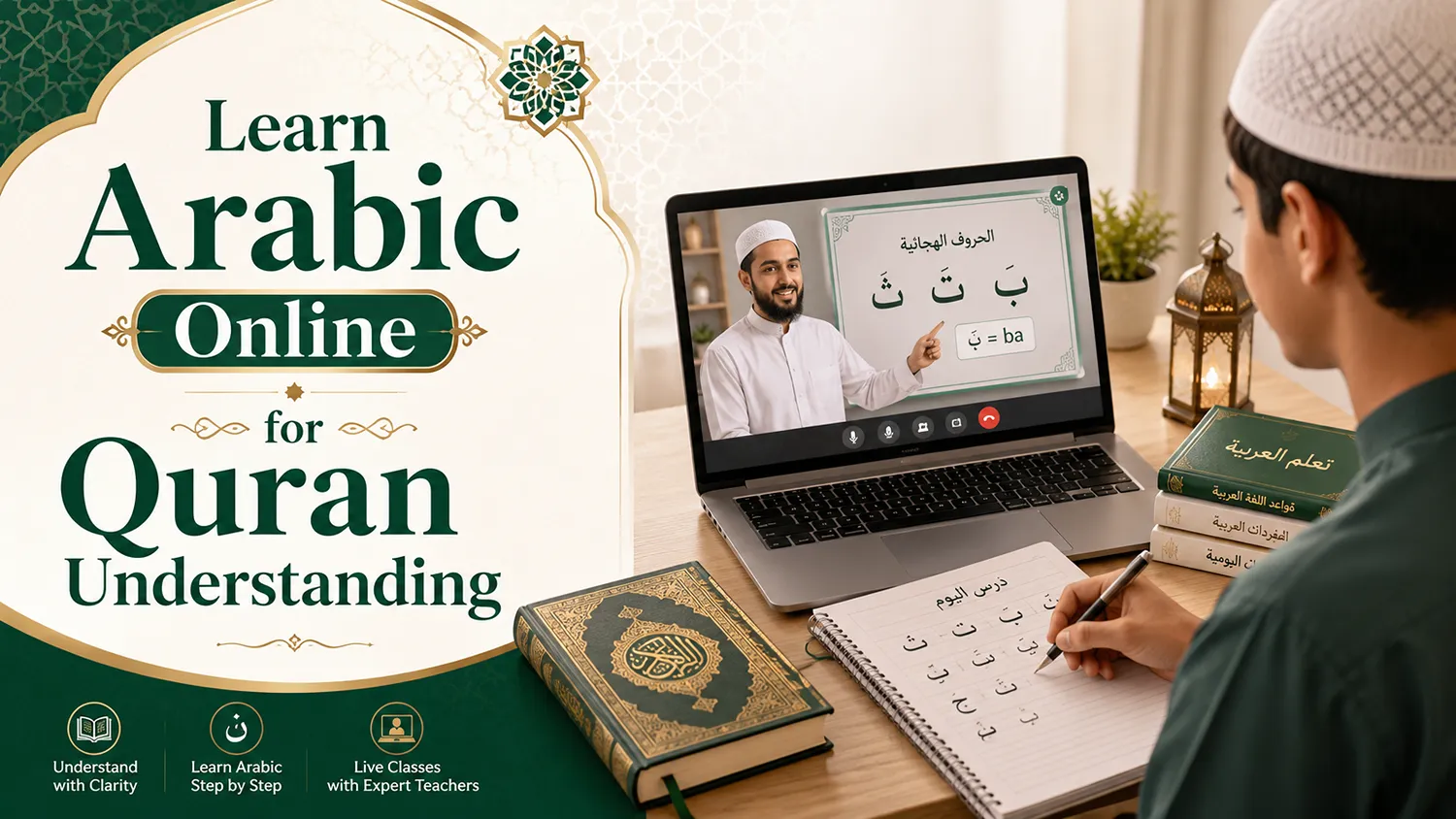
Learn Arabic Online for Quran Understanding
Many parents ask us the same question during a free trial call: “My child can read Quran with good Tajweed, but does she actually understand what she’s reciting?” That question is exactly why the search to learn Arabic online for Quran understanding has grown so much among Muslim families abroad. You don’t need to become fluent in everyday conversational Arabic to unlock the meaning behind the verses you recite. A focused, beginner-friendly approach to Quranic Arabic — taught one-on-one over Zoom, Teams, or WhatsApp — can turn recitation into real comprehension within months, not years. This guide walks through what that actually looks like, and where to start.
Why So Many Muslims Want to Learn Arabic for the Quran
If you grew up reciting Quran in a madrassah, or learned Tajweed as a child, you know the feeling. You can read the Arabic script beautifully, hit every makhraj correctly, and still not know what the ayah you just read actually means. For families raising kids in the USA, UK, Canada, Australia, or the Gulf, this gap often feels even wider, since English is the home language and Arabic can feel like a locked door.
That’s exactly why so many parents search for a Quranic Arabic course online, hoping to find one place that teaches reading and meaning together instead of treating them as separate subjects. This is the philosophy behind eQuran Zone’s approach to online Quran education, and it shows up clearly in our Islamic Studies for Kids course, where children pick up Quranic vocabulary alongside stories about the Prophets and everyday Islamic practice, rather than through dry grammar drills.

Quranic Arabic vs Everyday Spoken Arabic
Here’s the good news: you don’t need to learn Egyptian slang or master Gulf dialect small talk to understand the Quran. The Arabic of the Quran is Classical Arabic, a distinct literary register that predates the everyday spoken dialects used across the Arab world today. According to Wikipedia’s entry on Classical Arabic, this form has been used since the 7th century and is the direct ancestor of Modern Standard Arabic, the version taught in schools and used in news broadcasts.
This matters for learners because it narrows the target. You’re not trying to learn how to order food in Cairo or chat with a cousin in Dubai — you’re learning a more structured, grammatically consistent form of the language, built around a fixed and unchanging text. Once you learn the patterns behind Quranic Arabic, they apply to every surah, every juz, the same way, every time. That consistency is what actually makes it manageable, even for adult beginners with zero prior Arabic exposure.
How Learning Arabic Deepens Your Understanding of the Quran
Translations are helpful, but they’re still one person’s interpretation of the original words. Arabic works on word roots, usually three letters, that branch into a whole family of related meanings. Take the root r-h-m: it gives you Rahman and Raheem (two of Allah’s names), rahma (mercy), and rahim (womb) — all connected by the same idea of nurturing compassion. A translation alone won’t show you that thread. Understanding even basic Arabic will.
This is also where Tajweed and meaning overlap more than people expect. A pause in the wrong place, or stress on the wrong syllable, can shift meaning in small but real ways. That’s why our Tajweed Course doesn’t just teach pronunciation rules in isolation — tutors explain why a rule exists and what it protects in the meaning of the ayah. Students who pair Tajweed with even basic vocabulary tend to retain what they recite far longer than students who memorize sounds without any context.
What an Online Arabic Course Actually Covers
We’ll be upfront about something: eQuran Zone doesn’t run a standalone “Arabic Language” course as a separate product. Instead, Arabic learning for Quran purposes is woven directly into two of our core programs — the Quran Reading course and the Tajweed Course. This is intentional. Vocabulary learned apart from actual Quranic text tends to fade quickly. Vocabulary learned while reading real ayahs tends to stick.
If your only goal is to learn Arabic to read Quran with real comprehension, rather than to hold a conversation in Arabic, you don’t need a full language degree. You need focused, guided practice tied directly to the text you already recite. In practice, a typical journey with us looks like this: absolute beginners start with Noorani Qaida to master the alphabet, harakat (vowel signs), and joining letters. From there, students move into the Quran Reading course, where tutors introduce common Quranic words, word-for-word meaning of short surahs, and basic sentence patterns.
Every session is one-on-one, live over Zoom, Microsoft Teams, or WhatsApp video, with both male and female tutors available so families can choose whatever feels comfortable. You can see how each program connects to the next on our All Courses page.
Who This Is For: Kids, Adults, and Complete Beginners
Parents often ask if their child is too young to start learning Arabic meaning alongside recitation. In our experience, kids as young as six or seven can grasp simple word meanings once they’re comfortable with Noorani Qaida. Our Islamic Studies for Kids course reinforces this further, weaving Arabic vocabulary into stories so it never feels like a grammar lesson.
Adults are a different story, in a good way. Grown learners often move faster through basic Quranic Arabic because they can handle abstract grammar concepts that would bore a child. Our Quran Classes for Adults page has more detail on how one-on-one sessions fit around work schedules and family life. And if you’re already memorizing Quran, understanding meaning isn’t optional extra credit — it genuinely makes memorization easier and more permanent. That’s part of why we tie meaning instruction into our Hifz Quran program from an early stage rather than leaving it for later.
How Long It Actually Takes
This is the question every parent and every adult learner wants a straight answer to, and the honest one is: it depends on your starting point and how often you attend class. A student with zero Arabic background who takes three or four thirty-minute one-on-one sessions a week can usually recognize common Quranic words and follow basic word-for-word meaning within four to six months. Reaching a stage where you can follow tafsir notes on your own takes longer, often a year or two of steady practice, but you’ll notice small wins from the very first weeks.
Consistency beats intensity here. A student attending three short sessions weekly for a year will typically retain more than someone cramming long sessions sporadically. Our Pricing page breaks down the Basic, Standard, and Premium plans (three, four, or five classes a week), so you can pick a pace that actually fits your family’s schedule rather than an ambitious one you’ll abandon in a month.
Choosing the Right Online Quran Academy for This
Not every Quranic Arabic course online is built the same way. Look for one-on-one sessions rather than large group classes, since vocabulary and grammar corrections need individual attention — a tutor can’t catch a child’s mispronunciation of a root letter in a class of fifteen students. Ask, too, whether tutors explain meaning as they teach reading, or treat the two as separate tracks that never quite connect.
You can read more about our teaching approach and tutor backgrounds on our About page, or browse practical explainers on Quranic study over on our Online Quranic Studies blog category. If you have questions before committing — timing across time zones, tutor gender preference, a child’s age — our Contact page and WhatsApp chat are both quick ways to get answers from a real person, not a bot. We also keep a handful of free guides on our Resources page if you’d like to test the waters before booking anything.
The best way to know if this approach fits your family is to try one class. Our free trial removes the guesswork — you sit in on an actual one-on-one session, see how the tutor explains meaning alongside recitation, and decide from there.
Frequently Asked Questions
Do I need to learn Arabic to understand the Quran?
Not entirely. You can start with a good translation and tafsir, and many students do. But learning even basic Quranic Arabic gets you closer to the original meaning, since translations flatten out nuances in Arabic word roots that don’t always survive into English. Most students combine both approaches as they progress through their classes.
How long does it take to learn basic Quranic Arabic?
Most students recognize common words and follow basic word-for-word meaning within four to six months of consistent one-on-one classes, taken three to four times a week. Fuller comprehension, where you can follow tafsir independently, usually takes a year or more of steady practice.
Is Quranic Arabic different from spoken Arabic?
Yes. Quranic Arabic is Classical Arabic, a formal literary register distinct from the spoken dialects used in everyday conversation across Egypt, the Gulf, or the Levant. You don’t need to learn any regional dialect to understand the Quran, since Classical Arabic is a separate, more consistent form of the language.
Can children learn Quranic Arabic online?
Yes, and many do well with it once they’ve completed Noorani Qaida and are comfortable reading Arabic script. The Islamic Studies for Kids course introduces vocabulary through stories, which keeps it engaging rather than feeling like a grammar drill.
Do I need to know Arabic before starting Tajweed classes?
No prior Arabic knowledge is required. The Tajweed Course starts with pronunciation and articulation points, and tutors naturally introduce relevant vocabulary and meaning as lessons progress.
Is one-on-one better than group classes for learning Quranic Arabic?
For most learners, yes. Arabic pronunciation and word recognition benefit from immediate, individual correction, which is hard to get in a group setting. All eQuran Zone classes are one-on-one for exactly this reason.
Conclusion
Understanding the Quran in its original language isn’t reserved for scholars or people who grew up speaking Arabic at home. With the right structure — one-on-one sessions, a tutor who explains meaning alongside recitation, and a pace that fits your week — most learners notice real comprehension within months, not years. Whether you want this for your child or for yourself, the starting point is the same small step.


