
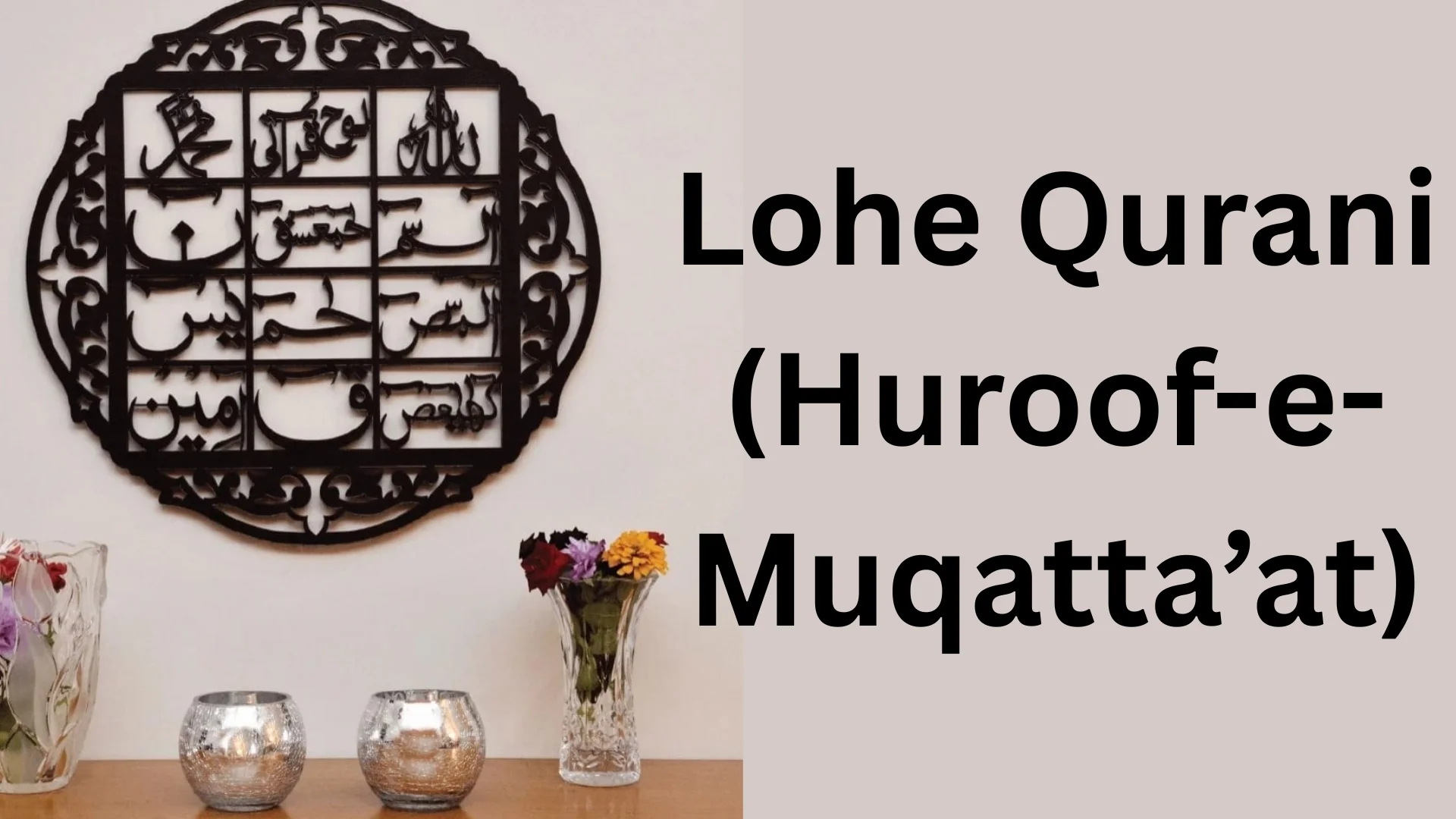
Lohe Qurani refers to the calligraphic art of specific letters from the Quran. These are the Huroof-e-Muqatta’at, or disjointed letters. They appear at the start of 29 chapters, called surahs. The letters are pronounced individually, such as “Alif-Laam-Meem.”
Islamic scholars agree that the exact meaning of these letters is known only to Allah. Their purpose remains a divine secret. However, many researchers reflect on their significance. They suggest the letters highlight the Quran’s miraculous nature. The book uses ordinary Arabic letters to create an unmatched, divine text that humans cannot replicate.
These beautiful letters connect people to their faith in a visible way. Displayed respectfully in a home, the Lohe Qurani serves as a constant reminder of Allah’s words. It is a symbol of devotion, turning a simple space into one filled with spiritual remembrance. Blessings and protection come from Allah, and this art is a way to keep Him in mind.
What is Lohe Qurani?
Lohe Qurani translates to “Quranic tablet.” The term commonly refers to art, calligraphy, or plaques featuring specific letters from the Quran. These letters are the Huroof-e-Muqatta’at, which means “the disjointed letters” or “the abbreviated letters.”
These are not words with conventional meanings. Instead, they are individual Arabic letters pronounced separately. For example, the letters Alif, Laam, and Meem (الم) at the start of Surah Al-Baqarah are read as “Alif-Laam-Meem,” not as a single word. Their appearance is a unique feature of the Quranic text.

The Mystery and Significance of Huroof-e-Muqatta’at
The exact meaning of the Huroof-e-Muqatta’at is known only to Allah. This is the consensus among the vast majority of Islamic scholars. The letters are considered part of the mutashabihat, the allegorical or ambiguous verses of the Quran. Their ultimate wisdom remains a divine secret. This mystery itself serves a purpose. It reminds believers of the limits of human knowledge. It encourages humility before the divine word.
Scholars have offered reflections on their possible significance. Some suggest the letters highlight the miraculous nature of the Quran. The Quran is composed of the same letters that people use in everyday Arabic. Yet, no human has ever been able to produce a text of similar eloquence, depth, and impact. The letters stand as a testament to the Quran’s divine origin. They challenge humanity to recognize that this book, made from familiar letters, is beyond human capability.
Where Do These Letters Appear?
The Huroof-e-Muqatta’at introduces 29 surahs of the Quran. These letters are drawn from a specific set of 14 unique Arabic letters. They are arranged in 14 different combinations, ranging from a single letter to a group of five.¹ These combinations are:
Lohe Qurani Single Letters:
- ص (Sad) – Surah Sad (38)
- ق (Qaf) – Surah Qaf (50)
- ن (Nun) – Surah Al-Qalam (68)
Lohe Qurani Two-Letter Combinations:
- طه (Ta-Ha) – Surah Taha (20)
- طس (Ta-Sin) – Surah An-Naml (27)
- يس (Ya-Sin) – Surah Ya-Sin (36)
- حم (Ha-Mim) – Found in seven consecutive surahs from Ghafir (40) to Al-Ahqaf (46)
Three-Letter Combinations Lohe Qurani :
- الم (Alif-Lam-Mim) – Surah Al-Baqarah (2), Aal-e-Imran (3), Al-Ankabut (29), Ar-Rum (30), Luqman (31), As-Sajdah (32)
- الر (Alif-Lam-Ra) – Surah Yunus (10), Hud (11), Yusuf (12), Ibrahim (14), Al-Hijr (15)
- طسم (Ta-Sin-Mim) – Surah Ash-Shu’ara (26), Al-Qasas (28)
Lohe Qurani Four-Letter Combinations:
- المص (Alif-Lam-Mim-Sad) – Surah Al-A’raf (7)
- المر (Alif-Lam-Mim-Ra) – Surah Ar-Ra’d (13)
Lohe Qurani Five-Letter Combinations:
- كهيعص (Kaf-Ha-Ya-‘Ayn-Sad) – Surah Maryam (19)
- حم عسق (Ha-Mim-‘Ayn-Sin-Qaf) – Surah Ash-Shura (42)²
This precise and consistent placement across different chapters underscores their deliberate inclusion in the divine revelation.
Lohe Qurani in Culture and Homes
Beyond their textual presence in the Quran, the Huroof-e-Muqatta’at have found a place in Islamic culture as Lohe Qurani. This often takes the form of calligraphic art. People display these pieces in their homes and offices.
The act of displaying the Lohe Qurani is a way to keep the remembrance of Allah present in one’s surroundings. It is a visual cue that connects a space to the sacred words of the Quran. Believers often feel a sense of peace and spiritual tranquility by having these divine letters in their sight. The beauty of the calligraphy itself is a cherished Islamic art form. It celebrates the elegance of the Arabic script, the language of the revelation.
Respectful Display of Lohe Qurani
If you choose to display Lohe Qurani artwork, it is important to treat it with the respect due to all Quranic verses. Here are some best practices:
Choose a Clean and Elevated Place
Hang the artwork on a clean wall in a respectable location. It should not be placed low to the ground or in an area associated with impurity, such as a bathroom.
Handle with Care
When handling the plaque or frame, ensure your hands are clean. Treat it with the same reverence you would give to a physical copy of the Quran.
Position it Respectfully
Place it in a main living area, study, or prayer space. This ensures it serves as a constant, dignified reminder of faith.
Beliefs, Blessings, and Superstition
Many people associate Lohe Qurani with attracting blessings (barakah) and spiritual protection. The belief is that the presence of anything from the Quran sanctifies a space. It invites divine mercy. Seeing the letters can prompt a person to remember Allah, which is in itself a blessed act.
It is important to understand the source of these blessings. Protection and benefit come from Allah alone. The Lohe Qurani is a physical object. It does not possess inherent power. Instead, it is a means of remembrance. True protection comes from sincere faith, regular prayer, and reciting Quranic verses like the Ayat al-Kursi and the last three surahs. The Lohe Qurani serves as a beautiful symbol of that faith, not a substitute for it.
Conclusion
The Huroof-e-Muqatta’at are more than just letters. They are a profound symbol of the Quran’s divine nature. Their mystery invites us to approach the Quran with humility. It reminds us that our understanding is finite, while Allah’s wisdom is infinite. When we look at a Lohe Qurani, we see letters that form the foundation of a divine message. This can inspire personal reflection. Just as these individual letters come together to form guidance for all humanity, our individual actions should come together to build a life of integrity, compassion, and faith. Contemplating these divine codes encourages us not only to believe but also to become better human beings.


