
Sometimes, life feels heavy. You might face challenges. You might feel lost. In these moments, a powerful prayer can bring comfort. The Quran offers a beautiful supplication for every situation. One of the most powerful is the dua of Prophet Musa (Moses). He recited it during a time of great need. This dua is “Rabbi inni lima anzalta ilayya min khayrin faqir.” It is a simple yet profound call to Allah for help.
This article will explore this special dua. We will uncover its meaning. We will learn its story. You will discover how to use it in your life. This prayer can open doors for you. It can bring goodness into your world.
The Story Behind the Dua
Every dua in the Quran has a story. This one comes from the life of Prophet Musa. The story is in Surah Al-Qasas, chapter 28 of the Quran. Prophet Musa was in a difficult situation. He had to flee Egypt. He traveled for days without a clear destination. And, he was alone. So, he was tired. He had no home. He had no resources.
Eventually, he arrived in a land called Madyan. He saw a group of shepherds watering their flocks at a well. He also noticed two women waiting patiently with their animals. They seemed unable to get close to the water. Prophet Musa, despite his own exhaustion, approached them. He asked why they were waiting. They explained their father was an old man. They had to wait for the other shepherds to finish.
Prophet Musa felt compassion. He immediately helped them. He drew water for their flock. Therefore, he did this act of kindness without expecting anything in return. After helping them, Musa (AS) sat under the shade of a tree. He had no food, no shelter, and no clear future. In that moment of complete need, he turned to Allah and said:
“My Lord, indeed I require whatever good You send down to me.”
Understanding the Words: A Breakdown
To truly appreciate this dua, we should understand each word. The phrase is short. Each part carries a deep meaning. Let’s look at the Arabic words one by one.
- Rabbi (رَبِّ): This means “My Lord.” It shows a close, personal connection to Allah. You are calling upon your Sustainer. You are calling upon the one who cares for you.
- Inni (إِنِّي): This word means “Indeed, I.” It is a word of emphasis. It confirms your state with certainty. You are presenting your situation to Allah honestly.
- Lima (لِمَا): This means “for whatever.” It is an open-ended request. You are not specifying what you want. You are leaving it to Allah’s wisdom.
- Anzalta (أَنزَلْتَ): This translates to “You send down.” It acknowledges that all good things come from Allah. He is the source of all blessings.
- Ilayya (إِلَيَّ): This means “to me.” It makes the supplication personal. You are asking for goodness to come directly to you.
- Min Khayrin (مِنْ خَيْرٍ): This means “of good.” Khayr is a comprehensive word. It includes anything beneficial. This could be food, shelter, a job, a spouse, or peace of mind.
- Faqir (فَقِيرٌ): This means “in need” or “poor.” It is a statement of ultimate humility. You are admitting your complete dependence on Allah. You are acknowledging your poverty without Him.
Full Meaning of the Dua
Now, let’s put all the words together. The full translation of “Rabbi inni lima anzalta ilayya min khayrin faqir” is:
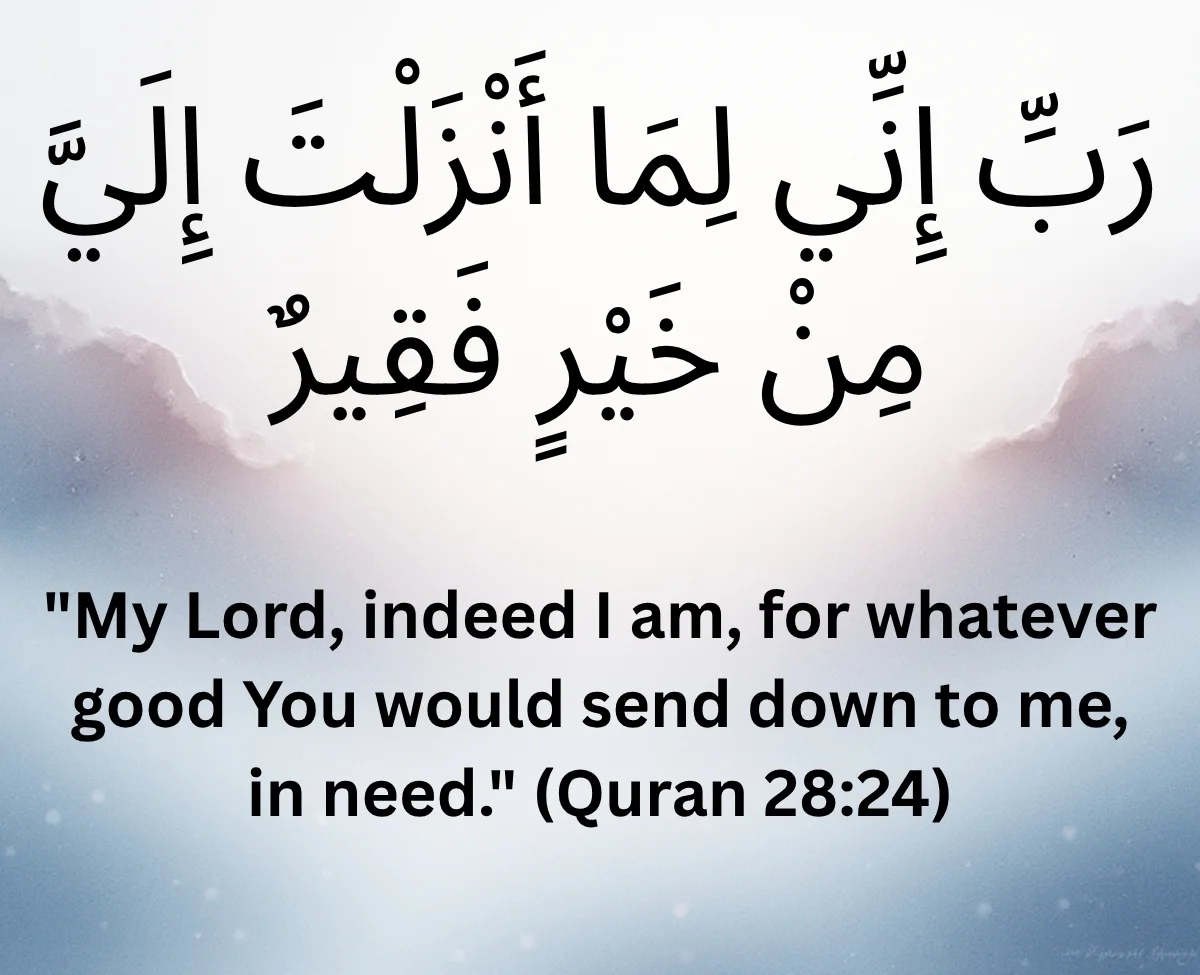
“رَبِّ إِنِّي لِمَا أَنْزَلْتَ إِلَيَّ مِنْ خَيْرٍ فَقِيرٌ
My Lord, indeed I am, for whatever good You would send down to me, in need.” (Quran 28:24)
This translation captures the essence of the dua. It is a humble admission of need. It is a hopeful plea for any form of goodness from Allah. Prophet Musa did not ask for a specific thing. He did not ask for a job or a house. He simply expressed his desperate need for khayr (goodness). This open-ended request shows complete trust in Allah’s plan. He knew Allah would send exactly what was best for him.
When Should You Recite This Dua?
This dua is universal. You can recite it at any time. Certain moments make it especially powerful. Recite it when you feel overwhelmed. Life can present many challenges. You might feel lost. This dua is a way to hand your worries to Allah.
Recite it when you are looking for something. This could be a job, a spouse, or a solution to a problem. The dua helped Prophet Musa find a home, a family, and security. Recite it after doing a good deed. Prophet Musa made this dua after helping the two women. Performing an act of kindness for others can open the doors of mercy for yourself. Recite it when you feel lonely or isolated. This dua reminds you that Allah is always with you. He is your ultimate provider.
Lessons from the Dua
Humility Before Allah
The dua teaches humility. It reminds us that no matter our position, we always remain in need of Allah’s help. Real strength comes from recognizing weakness before the Creator.
Trust in Allah’s Wisdom
Musa (AS) did not specify what kind of help he wanted. He said, “Whatever good you send.” This shows full trust in Allah’s plan. Sometimes, what seems small to us may be the start of great blessings.
Combine Effort with Prayer
Musa (AS) acted first — he helped the women — then he prayed. That balance is key. Islam teaches that effort and dua must go together. Do your part, then leave the results to Allah.
Dependence on Divine Provision
True believers understand that success, wealth, and comfort all come from Allah. Saying this dua keeps the heart grounded and grateful.
Gratitude and Contentment
When you accept that all good comes from Allah, you become more content. You learn to thank Him for small blessings and stay patient in difficulty.
How to Apply the Dua Correctly
Learning to say the dua correctly is important. Here is a simple transliteration to help you with pronunciation. Break it down into smaller parts.
Rab-bi / in-nee / li-maa / an-zal-ta / i-lay-ya / min khay-rin / fa-qeer
Practice each part slowly. Listen to recitations online to hear the correct sounds. The kh in khayrin is a sound from the back of the throat, like the “ch” in the Scottish word “loch.” The q in faqir is a deep sound from the back of the throat. Do not worry about perfection at first.
Steps to Recite It Effectively
- Start with Praise: Begin by praising Allah and sending blessings upon the Prophet Muhammad (peace be upon him).
- Say the Dua Clearly: Recite Rabbi inni lima anzalta ilayya min khayrin faqir with full focus.
- Reflect on the Meaning: Understand what you are saying — admit your need and depend on Allah.
- Maintain Sincerity: Speak from the heart. Allah loves honest supplications.
- Stay Patient: Allah answers in the best way and at the right time.
Common Misunderstandings
It’s Not Only for Marriage:
Some people think this dua is only for marriage. That’s incorrect. It covers every type of goodness — wealth, guidance, strength, and peace.
It’s Not a Quick Fix:
The dua is not a magic phrase. It’s a sincere call for Allah’s help. Results depend on His wisdom and timing.
It Requires Action:
Musa (AS) didn’t just pray. He acted first. The dua works best when paired with effort and faith.
Spiritual Benefits of the Dua
- It softens the heart and removes arrogance.
- It strengthens the habit of turning to Allah first.
- It increases patience during trials.
- It opens unseen doors of goodness and mercy.
- It creates peace within the heart, even in hardship.
The Deeper Message
This dua shows a beautiful balance between human weakness and divine mercy. Life often puts us in situations where control slips away. The words of this dua bring peace. They remind us that Allah never abandons His servants.
After Musa (AS) made this supplication, Allah provided him with shelter, food, safety, and later a new mission. This story shows that turning to Allah never goes unanswered.
Allah accepts your effort.
Conclusion
The dua “Rabbi inni lima anzalta ilayya min khayrin faqir” is more than a sentence. It is a mindset. It trains the heart to admit need, to trust divine timing, and to stay patient while waiting for good.
And, it invites humility into strength and gratitude into hardship. It teaches that Allah’s goodness never stops; it only comes at the right moment.
When life feels uncertain, whisper these words. Mean them with all your heart. Act righteously, trust sincerely, and let Allah handle the rest. True peace begins when you say,
“My Lord, I need whatever good You send down to me.”


