
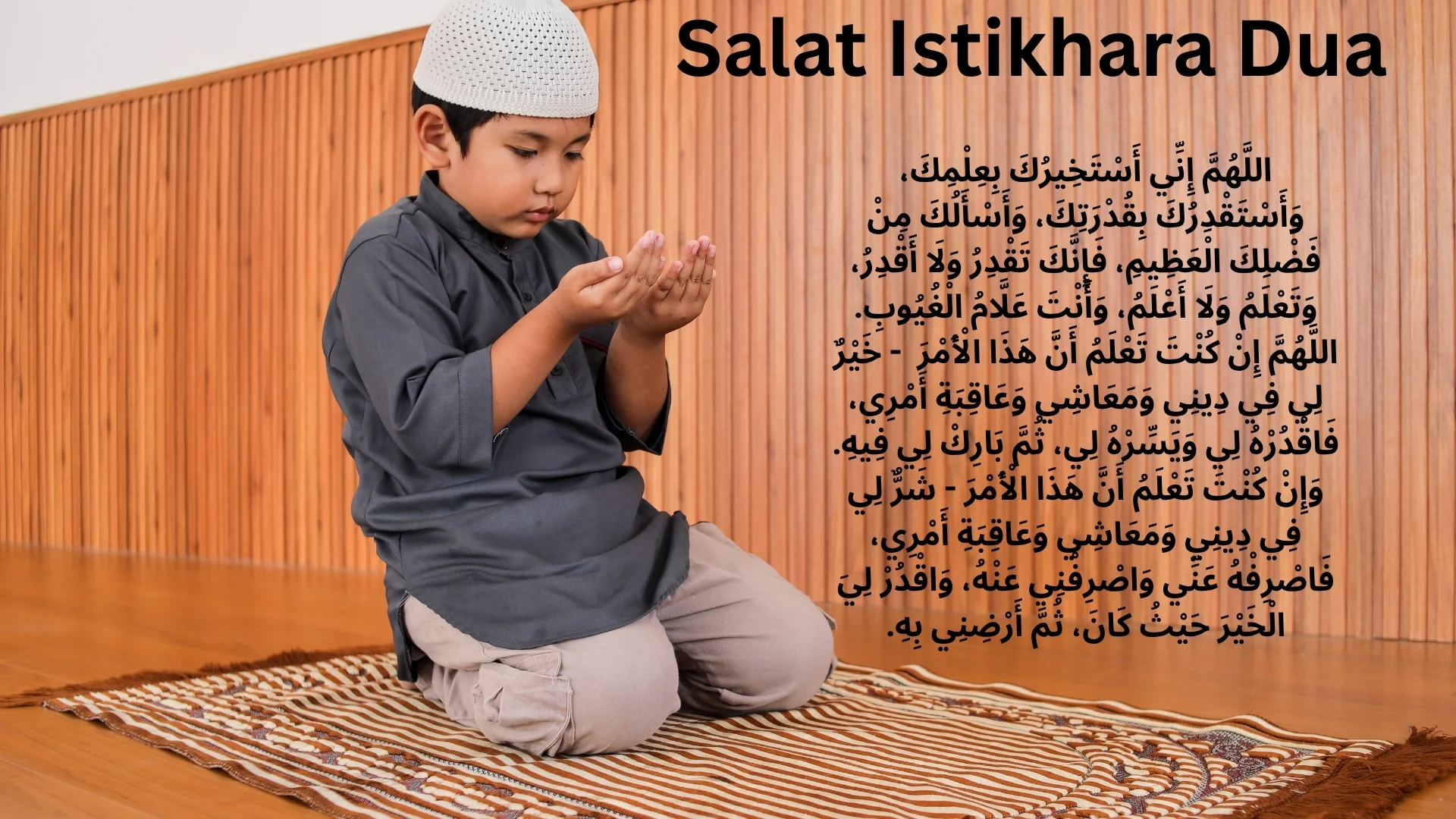
Salat al-Istikhara is a guidance prayer of the Sunnis. The Muslims then perform two rak’ahs and a special dua. They request Allah to direct them to the best. Moreover, they believe that He will save them out of evil. Then they go ahead and see how things develop.
Researchers, analysts, and scholars point out several important points. To begin with, there is high authenticity in the hadith of Sahih al-Bukhari. Then there is research on the decision-making commendation of Istikhara. It is consultation, effort, and surrender combined. Furthermore, researchers explain that there is no need to have signs. Rathe, the comfort or difficulties tend to come out following prayer.
Now, make your choice clear. Do your homework. Thereafter, recite two rakahs of prayers and say the dua. Then, take the way that appears. When the doors are closed, take it peacefully. Start today. Feel calm. Find clarity. Let Allah guide each step.
What is Salat al-Istikhara?
Salat al-Istikhara is the prayer to seek guidance. It is a voluntary prayer. It is practiced by a Muslim when he or she needs assistance in making a choice. Praying is a means of requesting Allah to lead you to the right decision. This is the prayer that was taught to his fellow Muslims by the Prophet Muhammad (peace be upon him). He urged them to make use of it for anything. This indicates the necessity to find divine assistance. Jabir ibn Abd-Allah al-Salami (may Allah be pleased with him) said, the Messenger of Allah (peace and blessings of Allah be upon him) had taught his companions to make Istikhara in everything. This has been quoted in Sahih al-Bukhari.

The Purpose of Istikhara
Istikhara is primarily aimed at making your decision to Allah. You do recognize His infinite knowledge. You request him to decide what would be good for you. This is not a prayer of seeing a particular sign or dream. It is concerning having faith that Allah will ease the right way. You do Istikhara already having done your research. One should always consult with wise and select individuals. Then, you seek Allah to get the last direction. This is a combination of individual effort and total faith in God.
When Should You Pray Istikhara?
You may pray Istikhara on any doubtful thing on which you are courageous. This consists of major choices in life. Some include making a marriage decision, taking up a job prospect, and relocating to a new city. It is also applicable to the small decisions, such as purchasing a car or initiating a project.
Pray Istikhara should not be made on obligatory or forbidden things. As an example, you do not have to consult Istikhara to know whether to do the daily prayers. In the same way, you do not do it on something that is obviously prohibited within Islam. Istikhara applies to the affairs that are permissible, and you have a free choice.
How to Perform Salat al-Istikhara
The procedure of Salat al-Istikhara is easy. It is a certain prayer and supplication (dua). Take the following steps into account.
Step-by-Step Guide
- To pray Istikhara, you need, first, the intention (niyyah) to do so. This is what you want in your heart. The reason why you are praying is to ask Allah to guide you concerning your issue.
- Then, proceed to do ablution (wudu) like in any other prayer. Make sure you are clean and in a clean place to pray.
- Thereafter, you make two voluntary units (rak’ahs) of prayer. These are recited as any other two rak Sunnah prayer. One should remember to repeat Surah Al-Kafirun in the initial rak’ah after the Al-Fatiha. In the second rak’ah, Surah Al-Ikhlas is recited after Al-Fatiha.
- Once you have finished two rak’ahs and made the last tasleem, you raise your hands. It is during this moment that the Salat Istikhara dua is recited.
The Salat Istikhara Dua
This act of worship centers on the dua. You must say it most earnestly and attentively. The original dua is the following one in Arabic.
The Dua in Arabic:
اللَّهُمَّ إِنِّي أَسْتَخِيرُكَ بِعِلْمِكَ، وَأَسْتَقْدِرُكَ بِقُدْرَتِكَ، وَأَسْأَلُكَ مِنْ فَضْلِكَ الْعَظِيمِ، فَإِنَّكَ تَقْدِرُ وَلَا أَقْدِرُ، وَتَعْلَمُ وَلَا أَعْلَمُ، وَأَنْتَ عَلَّامُ الْغُيُوبِ.
اللَّهُمَّ إِنْ كُنْتَ تَعْلَمُ أَنَّ هَذَا الْأَمْرَ – خَيْرٌ لِي فِي دِينِي وَمَعَاشِي وَعَاقِبَةِ أَمْرِي، فَاقْدُرْهُ لِي وَيَسِّرْهُ لِي، ثُمَّ بَارِكْ لِي فِيهِ.
وَإِنْ كُنْتَ تَعْلَمُ أَنَّ هَذَا الْأَمْرَ – شَرٌّ لِي فِي دِينِي وَمَعَاشِي وَعَاقِبَةِ أَمْرِي، فَاصْرِفْهُ عَنِّي وَاصْرِفْنِي عَنْهُ، وَاقْدُرْ لِيَ الْخَيْرَ حَيْثُ كَانَ، ثُمَّ أَرْضِنِي بِهِ.
English Translation:
“O Allah, I seek Your guidance by Your knowledge. I seek Your power by Your power. I ask You from Your great bounty. You have power, I have none. And, you know, I know not. You are the Knower of the unseen.
O Allah, if You know that this matter – [mention your matter here] – is good for me in my religion, my livelihood, and the end of my affair, then decree it for me, make it easy for me, and then bless me in it.
And if you know that this matter – [mention your matter here] – is bad for me in my religion, my livelihood, and the end of my affair, then turn it away from me and turn me away from it. And decree for me what is good, wherever it may be, and then make me content with it.”
When you reach the part “[mention your matter here],” you should state the decision you are facing.
Understanding the Outcome of Istikhara
There is a popular myth that you need to see a dream or a clear sign. This is not necessary. The outcome of Istikhara has varying outcomes. It is often easy to feel that Allah has made the way ahead. And then when it is a good thing with you, I think doors open like butter. You may have a feeling of comfort or temptation in your heart regarding that decision. Everything will just fall into place.
When the issue is not good for you, you will have obstacles emerging. The journey can become challenging. You may experience this feeling of disgust or discomfort in your heart. This is Allah
sending you away from what is harmful. The final and most significant step is to have faith in the process. You can continue with your decision; however, you must be attentive after you have prayed.
Common Mistakes to Avoid
There are instances when people commit errors during Istikhara. It is good to be aware of them.
- Waiting for a Dream: never postpone your decision in waiting. The advice is usually delivered by means of staging events.
- Praying Without Research: Istikhara does not mean that you should abandon your brains. Never stop doing your homework and consulting someone.
- Impatience: Have faith in the time of Allah. The way to do it right might not be apparent at the moment.
- Neglecting the Outcome: When you pray Istikhara and see that there are obviously impediments, then do not coerce. This is a sign to turn away.
To summarize, these are some of the pitfalls that should be avoided to enjoy the full benefits of the prayer.
Sincerity and Trust in Allah
To make your Istikhara effective, you need to be sincere (ikhlas). You must have only one purpose: to find the favor of Allah and His guidance. Eliminate individual prejudice or eagerness to achieve a particular result.
There is also the need to trust (tawakkul). Have faith in the fact that Allah knows everything. And he is right: he knows what is best at the time when you do not know it. This belief is a calmness to the heart. You can go on with your business with confidence that you have put your affairs in the right hands.
Finally, take action. Once you pray and reflect, make the decision that appears to be the best. Have faith that Allah will direct your ways. Salat al-Istikhara is not a passive one. It is of acquire divine wisdom to enable your actions. Your praying, along with an endeavour of yours, breaks a road open into the light and tranquility. This is a prayer of life, a beautiful prayer that transforms moments of doubt into ones of greater faith and boldness.


